

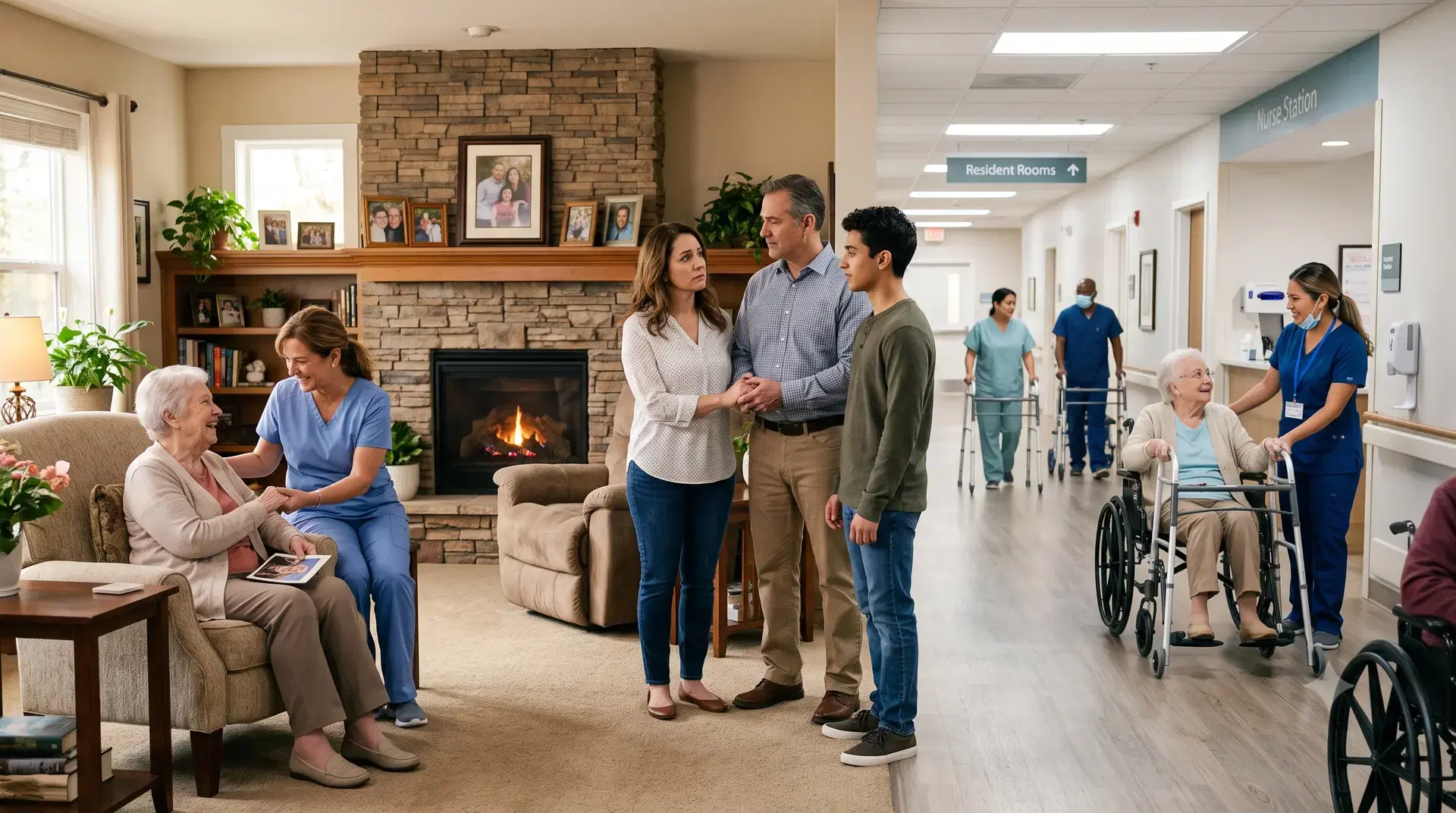
When your parent or grandparent can no longer live alone, two choices come up most often: an adult family home or a nursing home. Both give around-the-clock care — but they are very different places to live. This guide breaks down the key differences so you can pick what is right for your family.
What Is a Nursing Home?
A nursing home is a big building — usually with 30 to 100+ residents — that provides medical care every day. It is the right place for someone who needs things like wound care, IV treatments, or physical therapy after surgery. Registered nurses are on-site at all times.
Learn more about what skilled nursing involves on our Skilled Nursing Care page.
What Is an Adult Family Home?
An adult family home is a real house in a regular neighborhood, licensed to care for just two to six people. One caregiver looks after a small group, so your loved one gets personal attention — not a number on a chart.
Caregivers help with everyday needs like bathing, getting dressed, meals, and medications. Many adult family homes also care for people with memory conditions like dementia or Alzheimer's.
How Are They Different?
- Size: Nursing homes are large. Adult family homes are small — just a handful of residents.
- Attention: In a nursing home, one staff member may look after 10 or more people. In an adult family home, one caregiver looks after two to four.
- Feel: Nursing homes feel clinical — long hallways, set schedules, cafeteria food. Adult family homes feel like home — a real kitchen, a living room, a backyard.
- Medical care: Nursing homes handle complex medical procedures. Adult family homes handle personal care and medication management, but not medical procedures like IV therapy.
- Cost: Nursing homes in Washington often run $8,000–$12,000 a month. Adult family homes typically cost $3,500–$6,500 a month for a similar level of personal care.
When Is a Nursing Home the Better Fit?
A nursing home makes sense when your loved one needs daily medical treatment — for example, after a major surgery, or when a condition requires a registered nurse present at all times. For many families, it is a short-term step during recovery, not a permanent move.
If your loved one is coming home from hospital, our Post-Hospital Recovery Care page explains how we can help with the transition.
When Is an Adult Family Home the Better Fit?
An adult family home is often the right long-term choice when your loved one:
- Needs help with daily tasks — bathing, dressing, meals — but not medical procedures
- Has dementia or Alzheimer's and does best in a calm, familiar place
- Would feel lost or stressed in a large facility
- Wants consistent caregivers who know them by name
- Values home-cooked food and a quiet neighborhood setting
We also offer memory care, personal care services, and 24-hour elder care — all within our home.
What About Cost?
Here is something many families do not expect: adult family homes often cost less than nursing homes, even though the caregiver-to-resident ratio is much better. You are not paying for a large building, a cafeteria, or a big admin team.
If your loved one qualifies for Medicaid in Washington State, there are waiver programs that may help cover the cost. Ask us about this when you get in touch.
How Do You Choose?
Ask your loved one's doctor one simple question: Do they need skilled medical care, or personal care support?
If the answer is personal care — help with daily life, medications, and supervision — Fedrick Senior Care may be a great fit. If they need ongoing medical procedures, a skilled nursing facility may be needed first.
Either way, we are happy to talk it through with you honestly. No pressure. Reach out to us or come for a free tour and see our home for yourself.